ar
ar
 fr
fr

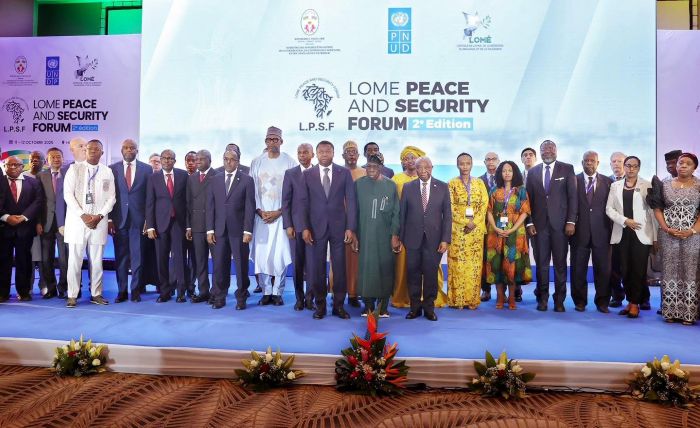
The second edition of the Lomé Peace and Security Forum (LPSF) was held on October 11–12, 2025, in the Togolese capital under the theme:
“Africa Facing Complex Security Challenges: How to Build and Sustain Peace and Stability in a Changing World?”
The forum was organized through close collaboration between the Government of Togo and the United Nations Development Programme (UNDP). The opening ceremony was presided over by Faure Gnassingbé, Prime Minister of Togo, in the presence of Joseph Boakai, President of the Republic of Liberia, and Olusegun Obasanjo, former President of Nigeria, along with several high-ranking political figures—including current and former prime ministers and ministers—scholars from Nigeria, Senegal, Kenya, South Africa, Mali, Somalia, Botswana, Zimbabwe, Morocco, Algeria, Togo, the Democratic Republic of Congo, Burkina Faso, and experts from Africa, Europe, America, and Asia.
The forum is part of Africa’s ongoing efforts to strengthen peacebuilding and consolidate collective security amid a regional and international context marked by the emergence of new areas of tension and increasingly complex security threats.
Over two days of discussions, participants explored five main themes:
1. The crisis in the Great Lakes region;
2. Africa’s strategic autonomy;
3. African youth and their challenges;
4. Artificial Intelligence (AI);
5. The continent’s key security issues.
- Statements from participating leaders
“Our world is going through a time of uncertainty, but I want Lomé to remain a place of clarity—a place where we dare to say that peace is not a naïve dream, but a strategy that requires commitment. I want Lomé to be a space where we speak with one voice and a constructive spirit, and where we propose a new vision of security based on autonomy, integration, prevention, and shared responsibility.”
- Faure Essozimna Gnassingbé, Prime Minister of Togo
“The peace we seek must be built within the continent, by Africans themselves, managed by Africans, and supported by Africans. The Liberian model has helped shape the African approach to peacebuilding—one that not only seeks to achieve peace but also addresses the root causes of conflict and prevents them while fostering regional cooperation. With the support of ECOWAS, the African Union, and the United Nations, as well as through liberal reforms, stronger security institutions, and the promotion of democracy, our peace has become intertwined with that of our neighbors.”
- Joseph Boakai, President of the Republic of Liberia
“The recommendations resulting from this forum represent a call for coordinated collective action. We must act now. The forum’s conclusions urge us to revive regional and continental cooperation mechanisms, invest in human capital, and strengthen our efforts in prevention and resilience.”
- Robert Dussey, Minister of Foreign Affairs of Togo
“We view this forum as an indispensable framework for pursuing peace across the continent. It sends a message of openness, but also reaffirms our sovereignty. Our goal is to take responsibility for our own security while remaining open to partnerships that respect our strategic choices and the vital interests of our peoples.”
- Abdoulaye Diop, Minister of Foreign Affairs of Mali
- Key themes discussed
Participants concluded that the security threats facing Africa are increasingly complex and interconnected—from terrorism and cyber threats to inter-state conflicts, maritime insecurity, the effects of climate change, youth exploitation, and the rise of violent extremism. These challenges demand bold and coordinated collective action.
- Final Declaration
The final communiqué of the forum focused on four main pillars:
1. Implementation of key operational measures;
2. Strengthening the continent’s strategic autonomy in the face of global geopolitical competition;
3. Integrating modern technologies and social actors into peacebuilding efforts;
4. Building sustainable peace that ensures stability and shared prosperity across Africa.
1. Toward Africa’s Strategic Autonomy
One of the central messages of the forum was the need to enhance Africa’s strategic autonomy—in both defense and development. African states were urged to mobilize greater domestic resources to finance their security, review defense agreements to better safeguard sovereignty, develop a continental defense industry, and invest in local technologies.
The forum also called on the African Union to play a key coordinating role in aligning security and defense initiatives and in redirecting international partnerships toward Africa’s core interests.
2. Artificial Intelligence: Threat or Opportunity?
A major new feature of this edition was the inclusion of Artificial Intelligence (AI) in the discussions on peace and security. AI was recognized as a vital strategic tool but also as a potential source of new risks if left unregulated or misused. African states were therefore encouraged to:
- Develop a continental protocol for the ethical and secure use of AI;
- Establish a dedicated fund to advance AI development across Africa;
- Promote digital and technological education among African youth.
3. Youth: The Engine of Sustainable Peace
The final declaration gave particular attention to the role of youth in peacebuilding. It called for:
- The creation of an African Youth Support Fund;
- Active inclusion of youth in local peace and security committees;
- Efforts to combat the economic, social, and political marginalization that fuels instability.
Participants also welcomed the historic decision adopted by the African Union—following a Togolese initiative—recognizing slavery, colonialism, and forced displacement as crimes against humanity and acts of genocide against African peoples, marking a key step toward historical justice.
4. The Great Lakes Region: A Continental Priority
The Great Lakes region remains one of the most critical areas for the continent’s stability, given ongoing conflicts, interstate tensions, and large-scale population displacement.
The forum called for:
- Strengthened dialogue among concerned states;
- Inclusive governance that respects human rights;
- Increased humanitarian assistance, particularly for affected women and children.
A Call for Concrete Action
The Lomé Declaration 2025, composed of 46 articles, serves as an ambitious yet pragmatic roadmap for a peaceful, resilient, and technologically sovereign Africa with economic independence.
At the close of the forum, participants expressed their appreciation for the leadership of President Faure Gnassingbé and for Togo’s active role in promoting lasting peace on the continent.
The Lomé Peace and Security Forum has proven to be more than an intellectual gathering—it has become a strategic platform for reflection, action, and coordination of African efforts to address 21st-century security challenges.
The main challenge now lies in turning these commitments into tangible actions on the ground. The next edition of the forum is scheduled to take place in Lomé in 2027.
References:
https://robertdussey.com/declaration-de-la-deuxieme-edition-du-lome-peace-and-security-forum-lpsf/
https://africa24tv.com/afrique-lafrique-trace-sa-propre-route-vers-la-paix
https://actubilan.tg/2e-forum-de-lome-sur-la-paix-et-la-securite-ce-quil-faut-retenir/