ar
ar
 fr
fr


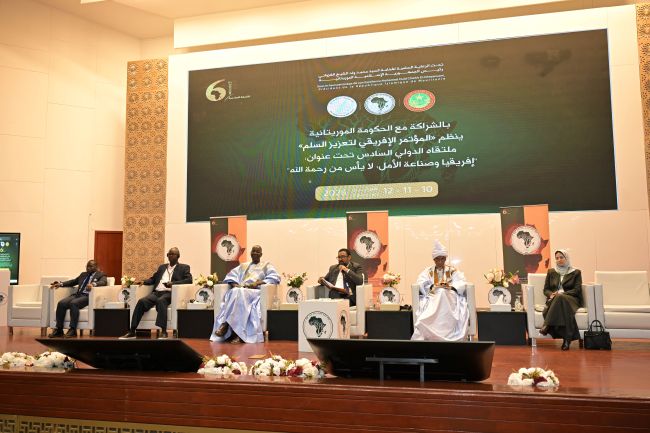
Nouakchott, Mauritania – February 12, 2026
Under the high patronage of His Excellency Mr. Mohamed Ould Cheikh El Ghazouani, President of the Islamic Republic of Mauritania, and the Abu Dhabi Forum for Peace, presided over by His Eminence Sheikh Abdallah bin Bayyah, the 6th African Conference for Promoting Peace was launched in the capital city of Nouakchott. The forum was organized in collaboration with the Mauritanian Government and with the support of the United Arab Emirates, held at the Al-Murabitoun International Conference Centre from February 10 to 12, 2026, under the theme: "Africa and the Making of Hope: No Despair of the Mercy of Allah."

The event was attended by a distinguished elite of world leaders, including ministers, high-ranking officials, religious figures, intellectuals, and researchers from across the globe and all African regions. The African Center for Research and Strategic Studies (ACRESS) marked a prominent participation in the forum's activities with a strategic research paper addressing hydro-political challenges and water security issues across the African continent.
Dr. Ghada Fouad, Director of the African Center for Research and Strategic Studies (ACRESS), participated as a keynote speaker in the seventh session titled "Economics of Hope: Sustainable Development and Water Security," chaired by Dr. Mohamed Mahjoub bin Bayyah, researcher at the Abu Dhabi Forum for Peace.
The Paradox of Economic Water Scarcity in Africa
In her presentation titled "Water Wars in Africa: How Water Scarcity Fuels Conflicts in Our Nations," Dr. Ghada Fouad reviewed the reality of water resources across the continent. She deconstructed the dilemma of water poverty and scarcity, explaining that while some countries possess abundant water resources, they suffer from "Economic Water Poverty." She highlighted that countries like the Democratic Republic of the Congo and Ethiopia represent models of the inability to utilize natural abundance. This failure often drives certain countries—particularly Ethiopia—to attempt to impose a new status quo through unilateral projects that severely harm the populations of downstream countries, namely Egypt, Sudan, and Somalia, across their shared international rivers.

Water Security: Between Scientific Concept and Political Sovereignty
The Director of "ACRESS" defined water security through two dimensions:
- The Scientific Dimension: Pertaining to the abundance and quality of water for consumption and daily use.
- The Political Dimension: Pertaining to "Water Sovereignty" and the state's capacity to protect its resources from external threats. Dr. Fouad warned against upstream countries utilizing water as a geopolitical leverage. She emphasized the necessity of balancing power relations (Hydro-politics) through binding legal agreements that prevent upstream countries from monopolizing water-related decisions and safeguard the rights of downstream nations, as seen in the disputes over the Nile, Juba, and Shabelle river basins.

Existential Threats Due to Water in Africa
In her research paper, Dr. Ghada Fouad identified three primary risks threatening rivers and freshwater in Africa:
- Political Obstinacy: The unilateral management of shared rivers by upstream countries, disregarding the interests and vital needs of downstream populations.
- Neglect and River Pollution: Triggers conflicts resulting from deteriorating water quality; citing the Congo River and the Chari River in Chad as prime examples.
- Climate Change: Its direct impact on reducing river inflows, as currently observed in the Zambezi River.
Case Study: Risks of the GERD on Egyptian and Sudanese National Security
The Director of "ACRESS" dedicated a pivotal part of her study to analyzing the conflict in the Nile Basin, warning of the negative impacts of the unilateral management of the Grand Ethiopian Renaissance Dam (GERD) and other Ethiopian dams. Dr. Ghada detailed the hydrological and structural risks faced by Egypt and Sudan:
- In the Short-Term: Uncoordinated water discharges from the GERD in November 2025 led to severe flooding, submerging homes and agricultural crops in both Egypt and Sudan.
- In the Medium-Term: The new operational system of the dam will alter the natural seasonal flow of water, affecting groundwater recharge and salinity levels. This threatens agricultural yields, farmers' livelihoods, and the food security of Egypt and Sudan, especially in the absence of joint management, information exchange, and transparency.
- In the Long-Term (Existential Geological Risks): Dr. Fouad warned of a tectonic risk involving the acceleration of the Great Rift Valley split due to the immense water pressure of the dams in a region characterized by intense seismic and volcanic activity. She cited recent scientific evidence, including the eruption of the Hayli Gubbi volcano in the Afar region (November 2025) after being dormant for 12,000 years, alongside increased seismic activity. These events reinforce concerns regarding the fragility of the lithosphere around Ethiopian dams, threatening regional peace and lives across East and North Africa.

In conclusion, Dr. Ghada Fouad emphasized that the unilateral management of projects by upstream countries constitutes a grave environmental and geopolitical threat. She asserted that this situation necessitates urgent international intervention to enforce rules of joint management and transparency, thereby safeguarding the future of development and economic growth across Africa.
watching the ACRESS Participation on Youtube please press the link:
https://www.youtube.com/watch?v=851XH3Tq-1w