ar
ar
 fr
fr


23 August 2025
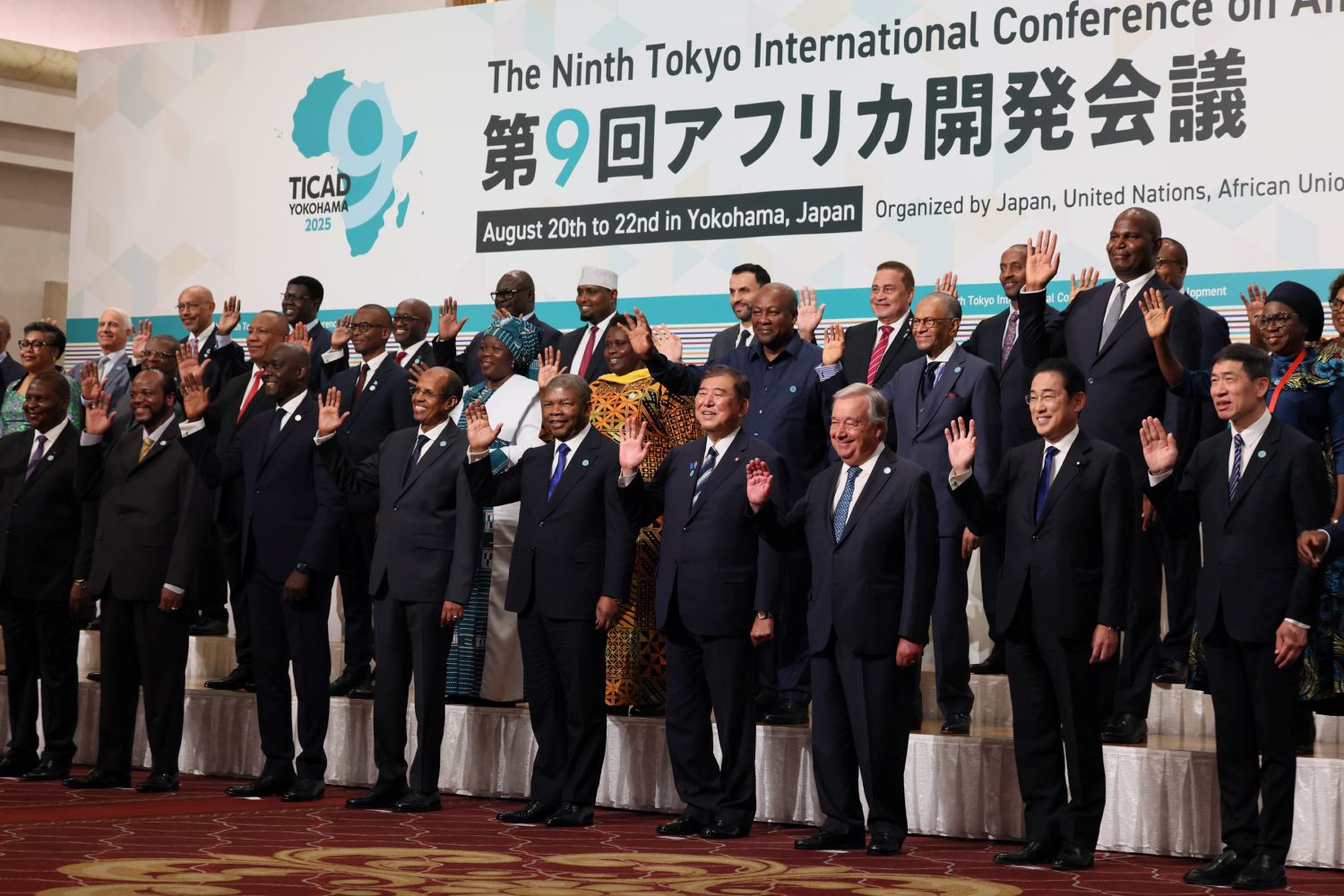
The ninth session of the Tokyo International Conference on African Development (TICAD 9) was convened under the theme “Co-creating Innovative Solutions with Africa” from 20 to 22 August 2025 in Yokohama, Japan. The conference brought together leaders and representatives from 49 African states, alongside the United Nations, the World Bank, and representatives of international organizations and institutions, with the primary objective of increasing Japanese investment in the African continent. Participants included Nigerian President Bola Ahmed Tinubu, South African President Cyril Ramaphosa, Kenyan President William Ruto, and United Nations Secretary-General António Guterres.
Origins and Institutional Framework
Since 1993, the Government of Japan has led TICAD, in partnership with the United Nations, the United Nations Development Programme, the World Bank, and the African Union Commission. The summit is held every three years and addresses a broad range of issues, including governance, good governance practices, economic development, and security.
The initiative to establish TICAD emerged from Japan in the aftermath of the Cold War, at a time when international attention to Africa had markedly declined. The conference aims to strengthen dialogue and cooperation between African leaders and their development partners, while mobilizing support for African development initiatives. A distinctive feature of TICAD is the Japanese government’s sustained commitment to monitoring the outcomes of each conference cycle and ensuring their effective implementation. Equally significant is the systematic involvement of United Nations and international institutions responsible for development assistance in TICAD’s activities and initiatives, under Japanese oversight, with the objective of ensuring the sustainability of development aid and programs in Africa.
Themes and Outcomes of TICAD 9
At the opening of the conference, Japanese Prime Minister Shigeru Ishiba presented a framework for economic cooperation that integrates governments, the private sector, manufacturers, and experts. This framework seeks to promote free trade and to strengthen connectivity between the Indo-Pacific region and Africa, within a global geopolitical context characterized by profound transformations—particularly in Africa, where American and European influence has been declining while Chinese presence and influence have expanded significantly.
The Prime Minister also announced Japan’s commitment to mobilize USD 30 billion over a three-year period for diversified investments in Africa, covering infrastructure, agriculture, healthcare, renewable energy, and manufacturing. He emphasized that discussions would focus on leveraging Africa’s human and material resources as a driver of economic activity, linking African growth to Japan’s development and global prosperity.
The conference centered on three core pillars: building a sustainable society, promoting trade and investment, and achieving peace and stability. These pillars were articulated through several key priorities.
Supporting African Development and Economic Growth
TICAD 9 launched the initiative entitled the Africa–Indian Ocean Economic Zone, aimed at attracting Japanese companies and investments—particularly those operating in India and the Middle East—toward Africa. Through this initiative, Japan seeks to expand trade, support local economic growth, and strengthen its strategic presence on the continent.
Ahead of the high-level summit, an Investment Conference was held on 19 August 2025. Efforts focused on expanding existing investment agreements with Angola, Côte d’Ivoire, Egypt, Morocco, Mozambique, and Zambia, as Japanese investors sought to consolidate a sustainable long-term presence in Africa. The Japanese government also announced its intention to strengthen cooperation mechanisms, particularly in agriculture (notably rice cultivation), energy transition, and the management of financial risks associated with debt distress.
The conference underscored the need to mobilize additional financial resources to support economic development. Participating countries agreed on the importance of improving African countries’ credit ratings, strengthening public–private partnerships, and supporting the creation of decent employment opportunities, especially for youth and women. Furthermore, there was a reaffirmed commitment to supporting the African Continental Free Trade Area as a central driver for enhancing intra-African trade.
This aligns with the urgent need of African states to reduce or restructure their debt burdens, which constitute a major obstacle to African development and progress. This concern was articulated by South African President Cyril Ramaphosa in his address to the conference, where he stated that “the debt and liquidity crisis on the African continent affects the socio-economic environment and constrains governments’ ability to provide social safety nets for their citizens.”
The Yokohama Declaration also called for increased investment in infrastructure and the blue economy, while underscoring the importance of accelerating both digital and environmental transitions.
Food Security and Agriculture
Japanese leaders pledged to support smart agriculture initiatives and to develop innovation centers in the field of artificial intelligence to enhance the continent’s technological capacities. This commitment reflects a recognition of the importance of quality education linked to the labor market in Africa, where agriculture remains the primary source of income and employment for the vast majority of the population, thereby also underpinning food security across the continent.
Terrorism and Conflicts
Participants expressed deep concern over ongoing conflicts and terrorism, calling for joint measures to strengthen security, which was identified as a fundamental pillar of Africa–Japan relations.
As part of its contribution to enhancing security on the continent, Japan announced its full support for African countries’ efforts to achieve “a mine-free Africa.” This support will be provided through the Africa Mine Action Platform, recently established by Japan in cooperation with the United Nations Mine Action Service (UNMAS), with the aim of facilitating the exchange of mine-clearance technologies and expertise with African demining practitioners. It is noteworthy that Japan is chairing the Twenty-Second Meeting of the States Parties to the Anti-Personnel Mine Ban Convention this year.
Youth and Innovation
Particular emphasis was placed on youth and innovation, with the conference serving as a platform for the launch of the Tomoni Africa (“Together with Africa”) program, designed to promote training, creativity, and exchange between African and Japanese youth.
Women and Peacebuilding
The social and security dimensions also received significant attention from leaders and participants. Tokyo seeks to strengthen the role of women leaders in the Horn of Africa in cooperation with the Intergovernmental Authority on Development (IGAD), with the aim of promoting governance and the rule of law, as well as enhancing women’s participation in conflict resolution and climate change mitigation.
Japanese support for displaced women in Nigeria has already contributed to improving their livelihoods and strengthening their empowerment, reflecting the Japanese government’s firm conviction regarding the central role of women in sustainable peacebuilding and the importance of a gender-responsive approach.
During the conference, 300 cooperation agreements were signed between Japan and African entities, alongside the announcement of several initiatives addressing key challenges in a number of African countries, including:
- The signing of a Memorandum of Understanding between the Government of Japan and the African Development Bank to launch the sixth phase of the Enhanced Private Sector Assistance (EPSA6), aimed at mobilizing financial resources amounting to USD 5.5 billion for the period 2026–2028.
- The launch of the Co-Creation Initiative for a Shared Agenda with Nigeria, entitled “Solution of Social Challenges and Building Economic Resilience by Supporting Startups,” through which Japan intends to strengthen industrial development measures in Nigeria in cooperation with private companies.
- The launch of an initiative with Mozambique to resume work on the gas project that was suspended in 2021. This initiative aims to stabilize Cabo Delgado Province in order to restart the natural gas project—the largest liquefied natural gas project in Africa—by strengthening law enforcement systems and promoting reconstruction and development, thereby ensuring the stable operation of the LNG project and improving access to international markets, including Japan.
- The establishment of a regional cooperation initiative for a shared agenda among Mozambique, Malawi, and Zambia entitled “Strengthening the Global Supply Chain through Nacala Corridor Development,” announced on the occasion of the Ninth Tokyo International Conference on African Development (TICAD 9).
- The enhancement of joint research between the Egypt–Japan University of Science and Technology and universities in Japan and Africa, with the objective of developing the university into a regional hub.
- The signing of seven bilateral agreements between Angola and Japan in multiple fields, including water, health, culture, and maritime infrastructure.
In conclusion, it can be argued that the Ninth TICAD Summit was convened at a time of intensifying global economic crises, as the tariffs imposed by U.S. President Donald Trump have affected both developed and developing countries worldwide. Consequently, it has become increasingly important for governments to seek the opening of new markets and the establishment of new partnerships in order to protect their industries and to create alternative markets and suppliers capable of responding to the evolving dynamics of international trade.
Within this context, and alongside Japan’s commitment to the continuity of TICAD and its active role in supporting the African continent and its states, it is evident that the Japanese government is also keen to expand the presence of its national companies and to facilitate and encourage engagement with their counterparts across the African continent, at both public and private sector levels. This orientation is clearly reflected in the agreements and initiatives concluded during the conference. In his closing remarks, the Japanese Prime Minister expressed his hope that TICAD 9 would mark the beginning of a stronger partnership between Japan and Africa, emphasizing the importance of working together to support peoples and industries.
References:
[1] الهيئة العامة للاستعلامات، المشاركة المصرية في مؤتمر طوكيو الدولي للتنمية في أفريقيا "قمة تيكاد ٩": https://goo.su/zk99S
[2] Parliamentary Vice-Minister for Foreign Affairs ERI’s Attendance at the TICAD 9 Thematic Event “Toward a Mine-Free Africa: Launch Event of the Africa Mine Action Platform”, https://www.mofa.go.jp/ic/ha_er/pageite_000001_01195.html
[3] Ministry of foreign affairs of Japan, https://www.mofa.go.jp/ic/cap3/pageite_000001_01215.html , https://www.mofa.go.jp/ic/cap3/pageite_000001_01218.html
[4] Ninth Tokyo International Conference on African Development (TICAD9): Japan and African Development Bank sign agreement to extend Enhanced Private Sector Assistance for $5.5 billion sixth phase, https://goo.su/qIqrCe
[5] AAfrica: Ticad9 - 300 Japan-Africa Cooperation Agreements Signed, https://allafrica.com/stories/202508220161.html